The tenth edition of the diagnosis and treatment plan: what are the new changes? How to treat with traditional Chinese medicine more effectively? —— National Health Commission organized authoritative
Xinhua News Agency, Beijing, January 8th Question: the tenth edition of the diagnosis and treatment plan: what are the new changes? How to treat with traditional Chinese medicine more effectively? — — National Health Commission organized authoritative experts to interpret the tenth edition of Covid-19 infection diagnosis and treatment plan.
Xinhua News Agency reporters Li Heng and Wen Jinghua
The National Health and Wellness Commission and the State Administration of Traditional Chinese Medicine issued the "novel coronavirus Infection Diagnosis and Treatment Program (Trial Tenth Edition)" on January 6th. What are the new changes in the tenth edition of the diagnosis and treatment plan? In order to further improve the related content of TCM treatment, how to use TCM treatment more effectively? The National Health and Wellness Committee organized Liu Qingquan, Dean of Beijing Hospital of Traditional Chinese Medicine affiliated to Capital Medical University, and Wang Guiqiang, Director of Infectious Diseases Department of Peking University First Hospital, to give answers.
1. Q: What are the important changes in the tenth edition of the diagnosis and treatment plan?

Wang Guiqiang: According to the pathogenic characteristics, epidemic characteristics and new drug research and development progress of Omicron strain, the important changes in the tenth edition of the diagnosis and treatment plan are mainly reflected in the following aspects:
First, the name of the disease has been adjusted, and the name of the disease has been changed from "novel coronavirus" to "novel coronavirus infection", including asymptomatic infected people and symptomatic mild, moderate, severe and critical types.
Second, for the severely high-risk population, it is adjusted from the original age of 60 and above to 65 and above, emphasizing that people aged 65 and above who have not completed the whole vaccination are the key concern groups. From the current data at home and abroad, vaccination is an important factor to reduce the risk of severe illness and death. The elderly who have not been vaccinated or have not completed the whole vaccination and the high-risk population with basic diseases should continue to strengthen vaccination.
In the severe high-risk population, in addition to patients with diabetes, coronary heart disease, hypertension and other basic diseases, tumor patients, etc., there is an increase in continuous dialysis population, which is also likely to lead to severe illness and death risk at the peak of the epidemic.
Third, the "suspected case" is no longer judged. A "suspected case" means that there are epidemiological and clinical manifestations in clinic, and there is no pathogenic evidence. But now the pathogenic evidence has been expanded to Covid-19’s positive nucleic acid test or antigen test, which can be used as the diagnostic criteria. In most cases, there will be no cases where the epidemiological history and clinical manifestations are consistent with the characteristics of the disease, but the pathogen detection can not be clear for a long time.
After the elderly and other people with severe and high-risk diseases are definitely diagnosed as positive, they should report to the community in time, give early intervention, closely monitor the changes of their condition, and follow up, so as to achieve "moving forward".
The fourth is to adjust the "discharge standard", which no longer requires the results of nucleic acid test when the infected person leaves the hospital, and the clinician will make a comprehensive judgment based on the patient’s Covid-19 infection, diagnosis and treatment of basic diseases or other diseases, and health recovery.
The fifth is to improve the early warning indicators of severe cases in children, pay more attention to young children, especially children under the age of three, and closely monitor and follow up. For example, those with serious tendencies such as nervous system complications and milk refusal should be treated in time.
Sixth, the elderly who have not been vaccinated in the whole process will be added to the high-risk group of severe diseases, and the monitoring of vital signs, especially the monitoring index of finger oxygen saturation after rest and activity, will be added to the early warning index of severe diseases.
2. Q: The tenth edition of the diagnosis and treatment plan proposes to further improve the relevant content of Chinese medicine treatment. What are the specific aspects?
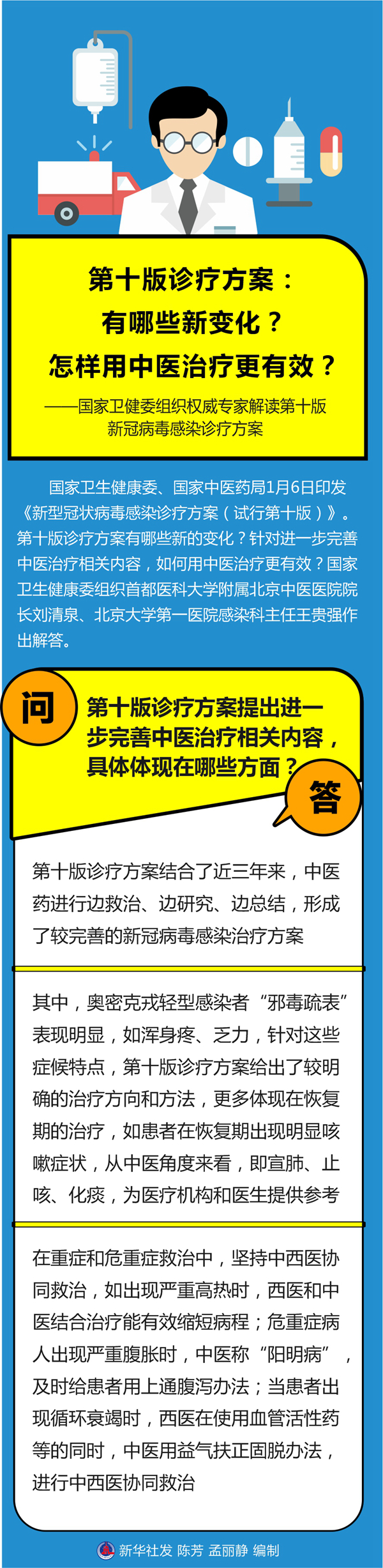
Liu Qingquan: The tenth edition of the diagnosis and treatment plan combines the treatment, research and summary of traditional Chinese medicine in the past three years, forming a relatively complete treatment plan for Covid-19 infection.
Among them, Omicron’s mild infected people have obvious symptoms of "evil toxin dispersing the exterior", such as pain and fatigue. According to these symptoms, the tenth edition of the diagnosis and treatment plan gives a clear treatment direction and method, which is more reflected in the treatment of recovery period. For example, patients have obvious cough symptoms in recovery period, from the perspective of traditional Chinese medicine, that is, dispersing lung, relieving cough and resolving phlegm, which provides reference for medical institutions and doctors.
In the treatment of severe and critical illness, we should adhere to the coordinated treatment of Chinese and western medicine. If severe high fever occurs, the combination of Chinese and western medicine can effectively shorten the course of disease. When severe abdominal distension occurs in critically ill patients, Chinese medicine calls it "Yangming disease", and the patient is given diarrhea in time; When the patient has circulatory failure, western medicine uses vasoactive drugs, while traditional Chinese medicine uses the method of supplementing qi, strengthening the body resistance and removing stagnation to carry out coordinated treatment of Chinese and western medicine.