Does the cooling-off period of divorce work?
[Introduction]
In 2021, 2.139 million couples divorced, down 40% from 2020. In 2021, the number of first marriages in China fell below 12 million for the first time in many years. Since the 21st century, the rising divorce rate in China has aroused widespread concern: the number of divorces nationwide has increased from 1.212 million in 2000 to 4.339 million in 2020.
So, is the cooling-off period of divorce really working?
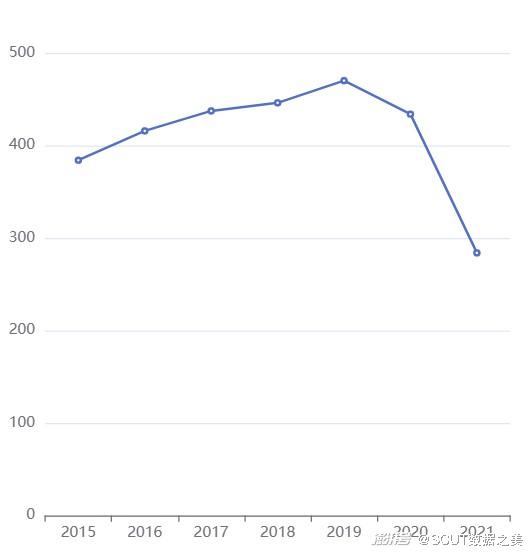
Figure 1: Changing trend of divorce logarithm (ten thousand pairs) in recent seven years.
Source: Bulletin of the Ministry of Civil Affairs over the years.
The Civil Code of People’s Republic of China (PRC) (hereinafter referred to as the Civil Code), which was formally implemented on January 1, 2021, promulgated the "cooling-off period for divorce" policy, the main content of which is: "Within 30 days from the date when the marriage registration office receives the application for divorce registration, any party who is unwilling to divorce may withdraw the application for divorce registration from the marriage registration office. Within 30 days after the expiration of the time limit specified in the preceding paragraph, both parties shall personally apply to the marriage registration office for a divorce certificate; Those who fail to apply shall be deemed to have withdrawn their application for divorce registration. "
As soon as the policy was introduced, it aroused a lot of disputes from all walks of life. Its supporters thought it would help reduce impulsive divorce, while opponents thought it would limit individual freedom of divorce.
Domestic changes
The relevant laws and regulations in the field of marriage in China have been revised and adjusted many times, and the current "divorce cooling-off period" system can be regarded as a binding policy specifically for divorce time. Since the reform and opening up in China, the evolution of relevant policies has been ups and downs. Here, we refer to the papers of Song Jian and Li Lingchun.(Song Jian & Li Lingchun, 2022)It is divided into four stages, and the divorce rate in each stage is discussed.
The first stage is1978-1993:The Marriage Law of the People’s Republic of China and related regulations have no clear provisions on the time and procedures for divorce;
The second stage isFrom 1994 to 2002:The civil affairs department implements a clear review procedure for marriage registration: the marriage registration administration organ will review the divorce application of the parties, and within one month from the date of accepting the application, those who meet the divorce conditions shall be registered;
The third stage is2003-2020:The provisions on divorce review have been abolished, and eligible divorce applicants can register for divorce on the spot and get a divorce certificate;
The fourth stage isJanuary 1, 2021 to present:Reset the one-month time threshold and implement the "divorce cooling-off period" system.
In these four stages, the binding policy of divorce time generally presentsbe on the throneandvacancyTwo states.
In summary, it is not difficult to see,“The policy of "cooling-off period for divorce" is not "unprecedented"It is a continuation of the previous related policies: the same is a binding policy on the time of divorce, and the time limit is one month. However, unlike in 1994, the policy of "cooling-off period for divorce" clearly states that the one-month time limit is no longer the "review" of the divorce time by the administrative organ, but the "self-examination" of both parties to the divorce application, and the initiative is transferred from the previous administrative organ to the applicant, which is conducive to ensuring the freedom of marriage.
Influence of the implementation of various divorce systems
After collecting and analyzing the divorce data from 1985 to 2021, it is not difficult to find that the divorce rate in China fluctuates obviously with the adjustment of the binding policy of divorce time. From 1994 to 2002, it was regarded as the period of divorce review system. In the Regulations on the Administration of Marriage Registration promulgated in 1994, the divorce review period of one month was explicitly stipulated for the first time:
Regulations on the Administration of Marriage Registration (approved by the State Council on January 12, 1994 and promulgated by Decree No.1 of the Ministry of Civil Affairs on February 1, 1994)
Article 16 The marriage registration authority shall examine the application for divorce of the parties concerned, and within one month from the date of accepting the application, register those who meet the divorce conditions, issue divorce certificates and cancel the marriage certificates. The parties shall dissolve the relationship between husband and wife from the time they obtain the divorce certificate.
During the implementation of the divorce review system in China (from 1994 to 2002), the divorce rate increased from 0.82‰ in 1994 to 0.90‰ in 2002.The average annual increase is 0.01 thousandths.This is different from that before the divorce review system was implemented (before 1994).The average annual increase is 0.04 thousandths.The growth rate is in sharp contrast with the rapid increase of divorce rate after the divorce review system was abolished in 2003.
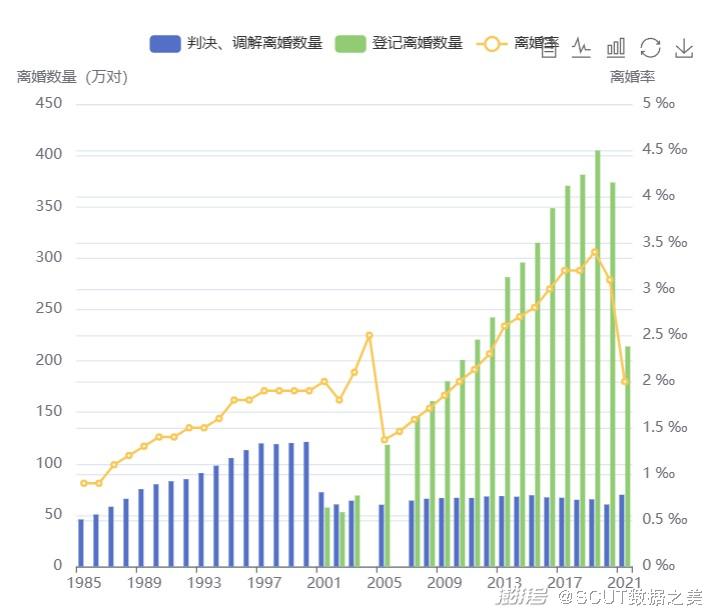
Figure 2: Logarithm of divorce and divorce rate in China from 1985 to 2021.
Source: Statistical Yearbook of China over the years.
By comparing the divorce rate data before and after the divorce review system was abolished, and the substantial change of divorce rate coincides with the time node when the divorce review system was abolished, it is not difficult to judge that the binding policy of divorce time has a significant correlation with the rise and fall of divorce rate.Divorce time, binding cancellation period,The number of divorce by agreement has increased.
During the implementation of the divorce review system from 1994 to 2002, the number of divorce by agreement was less than that by litigation. Although the proportion of divorce by agreement increased, it failed to exceed 50%. With the abolition of the divorce review system, the number of divorce by agreement exceeded the number of divorce by litigation for the first time in 2003, and its proportion increased rapidly. By 2020, the proportion of divorce by agreement in the total number of divorces has reached 86.10%, which is 6.2 times that of divorce by litigation. It can be seen that the sharp rise of divorce rate in China after 2003 is closely related to the simplification of divorce registration procedures, which makes many divorce by agreement completed on the spot, and the number of divorce by agreement increases rapidly, which in turn leads to the continuous increase of the total number of divorces.
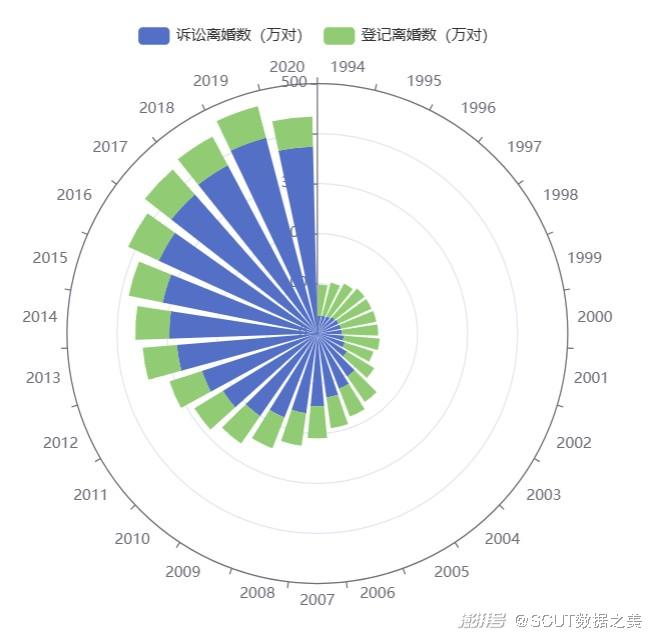
Figure 3: Number and proportion of different divorce types in China from 1994 to 2020.
Source: China Social Statistics Yearbook 2021, page 60, Table 2-15.
So, is the "divorce cooling-off period" equally useful?
The "cooling-off period for divorce" policy has been implemented for nearly two years, and the effect of the policy has gradually emerged. Using the divorce data of the whole country and all provinces, autonomous regions and municipalities directly under the Central Government released by the Ministry of Civil Affairs in official website in 2021, combined with the divorce data of the same quarter in other years, we can observe the changes of divorce level after the implementation of the "divorce cooling-off period" policy.
Looking at the number of divorces in 2021 according to the annual data
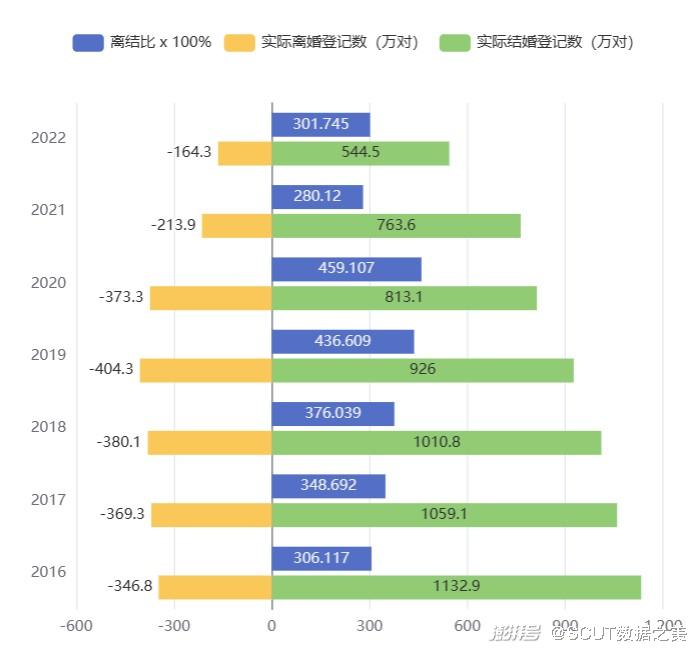
Figure 4: China divorce data and indicators in 2021.
Source: Statistical Bulletin of the Ministry of Civil Affairs
From the annual data, compared with the number of divorces in 2019 and 2020, the total number of divorce registrations in 2021 dropped sharply. According to the statistics of the quarterly report of the Ministry of Civil Affairs, a total of 2.139 million couples agreed to divorce in 2021, compared with 4.043 million couples in 2019.The decline was 47.1%; Compared with 3.733 million pairs in 2020,The decline was 42.7%.
From the analysis of paper data, the remarriage rate was higher before the cooling-off period, and it was greatly reduced after the cooling-off period was implemented. It is reasonable to speculate that divorce is a matter of calm thinking, and it will basically not be reunited.
• National changes before and after the implementation of the cooling-off period policy for divorce
We choose 2019 as the benchmark to eliminate the impact of COVID-19 outbreak and prevention and control.
The data shows that compared with 2019, the number of divorces in all provinces in China decreased in different degrees in 2021, with Heilongjiang Province, Jilin Province, Hebei Province, Inner Mongolia Autonomous Region and Liaoning Province (from high to low) having the largest decline.
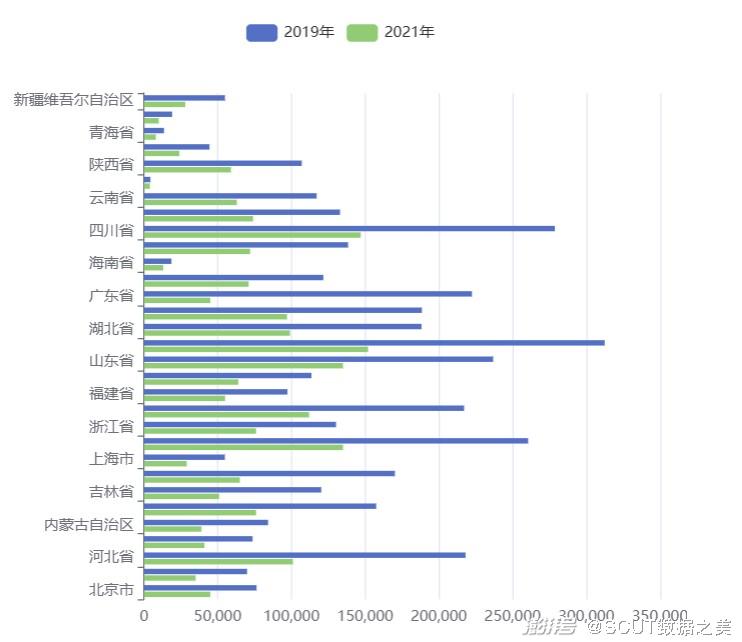
Figure 5: Number of registered divorces by province in 2019 and 2021
Source: Statistical Bulletin of the Ministry of Civil Affairs
Four cities with remarkable achievements
HangzhouIn 2021, there were 27,948 pairs of divorce applications accepted in Hangzhou. After the cooling-off period, there were 8,265 pairs who did not go to the marriage registration office together, and 16,615 pairs actually went through the divorce registration procedures, accounting for about 59.4%, and the proportion of failure to go through the divorce formalities on time was about. 29.6%.
ChongqingChongqing Civil Affairs Bureau said that in 2021, more than 50,000 divorced couples in the city decided not to divorce during the cooling-off period, and the number of divorces decreased compared with 2020. 44%.
QingdaoThe number of divorces in Qingdao dropped to the lowest level in 10 years in 2021, with only 16,000 couples getting divorced, a year-on-year decrease. 33%.
GuiyangThe local authorities in Guiyang found that among the couples seeking divorce, about 1/4 Can really calm down during the "divorce cooling-off period".
From the above data, it is not difficult to find that the cooling-off period policy has achieved initial cooling-off effect, but at the same time, we should also be clear that the existence of divorce logarithm as period data only reflects the comprehensive effect of population, social events, economy and culture in a certain period, and cannot be completely attributed to the influence of the policy.
International situation
By collecting relevant data, it is found that the policy of "divorce cooling-off period" to restrict divorce time is not original in China, nor is it the first time in China. Internationally, it is a common practice adopted by many countries and regions to set appropriate divorce procedures, such as binding provisions on divorce time, to delay divorce action, raise divorce threshold and achieve the effect of reducing impulsive divorce.
Russia:Russia’s Marriage and Family Law stipulates that it takes one month for a party to register for divorce after filing an application for divorce, and within one month from the date of filing an application, a divorce certificate will be issued to the party who meets the requirements at the expiration of the time limit.
South Korea:South Korea began to implement the "divorce deliberation period system" in 2008, and at the same time required the court trial procedure to handle the divorce formalities by agreement. After the husband and wife who intend to divorce jointly submit the application form and the agreement materials on child support and property distribution to the court, the court will issue a divorce confirmation letter, and the reflection period will be calculated from the date of receipt by both parties. If both parties fail to report to the household registration department within this period, the confirmation letter will be invalid. Couples with minor children have a gestation period of three months, and the rest have a gestation period of one month. After the deliberation period, if both parties still insist on divorce, the judge will grant the divorce on the spot.
Britain:British Family Law stipulates a "divorce consideration period" ranging from nine months to fifteen months. After receiving the divorce application from the parties, the court will first designate a nine-month reflection and consideration period for them, so that both parties can rationally think about their applications and make further judgments after the expiration. At the same time, the period can be suspended or extended according to the actual situation, and the divorce will be granted after the parties make arrangements.
France:The French Civil Code stipulates that a husband and wife may not file a divorce request within six months after marriage. "If the husband and wife insist on their divorce wishes, both parties should reapply after the three-month consideration period. If they do not reapply within six months after the expiration of the consideration period, the joint application will be invalid."
United States:States have stipulated different waiting periods for divorce. For example, couples in Ohio have a cooling-off period of 30-90 days after filing a divorce application, and reach a consensus and sign an agreement on some matters; Louisiana has set a time limit of 90-180 days, requiring both husband and wife to reach an agreement on the custody and support of their children.
double-edged sword
Reduce impulsiveness and rashness and give rational thinking time and space.
The starting point of setting up the "divorce cooling-off period" policy is to reduce impulsive divorce and rash divorce and try to protect the stability of marriage and family. Divorce is not only the separation of two people, but also the disintegration of a family. The "divorce cooling-off period" gives the parties sufficient time to think about the responsibility of raising and supporting children and the elderly in the family, protects the legitimate rights and interests of vulnerable groups such as women, children and the elderly, and gives them time and space for rational thinking on the principle of respecting the freedom of divorce, rather than the shackles that restrict people’s freedom of divorce.
Delay the pain of marriage and enter marriage cautiously.
The existence of rational time also means that the painful time of the parties facing unfortunate marriage is prolonged, and the increase of divorce time cost may also affect people’s more cautious entry into marriage, leading to a further decline in the level of marriage.
The long-term effect of insufficient data is doubtful.
The limited data volume and single dimension are not conducive to in-depth study of policy effects, such as the lack of data on the cancellation rate of divorce applications and the reasons for the breakdown of marriage relations. It is suggested to further strengthen the open development of marriage registration data with reference to foreign data, so as to better understand the facts and formulate more reasonable marriage policies.
Therefore, only by continuous development and perfection will divorce not be really difficult.
References:
Song Jian, Li Lingchun. Can the "divorce cooling-off period" policy reduce the level of divorce [J]. Exploration and contention, 2022(08):119-128+179.
Author | Feng Zhengfu Yu Xiaoxi Li Mingru
Instructor | Wu Xiaokun Li Wanyi
School | South China University of Technology
Editor | Liu Yu