Learn from the General Secretary | Supreme Leader: The solution lies in the masses.
On June 21st, 2004, the Supreme Leader published an article in Zhejiang Daily, entitled "The Way is among the Masses". The article points out that to solve contradictions and problems, it is necessary to go deep into the grassroots, the masses, worship the masses as teachers, and conduct in-depth investigation and research.
Worship the people as teachers and learn from the people are the remarkable characteristics of the supreme leader’s research work. He asked leading cadres to "put down their airs, throw themselves down, be grounded, and understand the situation" so as to "truly find out the problems faced by the masses, reflect their opinions, and sum up the experience created by the masses."

At the grassroots level, the top leaders attach great importance to listening to people’s voices, observing people’s feelings and reflecting public opinion. In 1982, when he first went to work in Zhengding, Hebei Province, he rode a bicycle to visit the village and understand the situation. The first triangular village in the county with a grain yield of over 1,000 kilograms per mu was the first stop of his research.
The Supreme Leader didn’t expect that what the local people said the most was "food is not enough to eat": "After one year’s work, you can’t eat until the end of the year", "Whoever doesn’t have enough to eat secretly goes to the village in the neighboring county to eat sweet potatoes" and "You see, this must be to eat sweet potatoes"? ? At that time, Zhengding’s annual grain purchase task was as high as 76 million Jin, and the remaining rations were far from enough for ordinary people to fill their stomachs.
"We definitely prefer not to ‘ National high-yield counties ’ This laurel must also let the people live a good life. " In order to reduce the grain purchase, the supreme leader resisted the pressure and ran to Beijing to reflect the actual situation. Soon, the central government and relevant departments at the provincial and local levels formed an investigation team, and found out the base by Zhengding, and reduced the grain purchase task to 48 million Jin, a decrease of 36.8%, greatly reducing the burden on farmers.
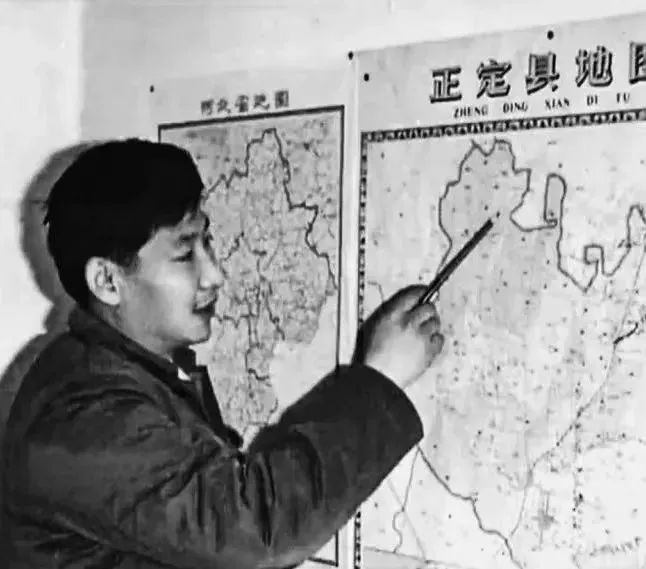
The supreme leader plans positive development in front of the office map. (Source: "Let the people live a good life — — Supreme leader positive definite footprint ")
To carry out investigation and study, the Supreme Leader emphasized that "the near and far should be visited, the good and the bad should be looked at, and the praise and criticism of cadres and the masses should be listened to", insisting that "one is one, two is two". But in reality, some people have encountered such troubles: after running for a long time, they collected a lot of opinions, but they just don’t know where to start to solve the problem. What should I do?
The supreme leader once mentioned his own experience and practice, "Insist on the beginning of research, open the way for research, keep your eyes down in everything, be a student first, be not ashamed to ask questions, ask questions from the grassroots and ask questions from the masses."
For example, in order to win the battle against poverty, the supreme leader put forward a precise poverty alleviation strategy. He said that the key to accurate poverty alleviation is to find out the target of poverty alleviation and clear the home chassis. This is the premise.
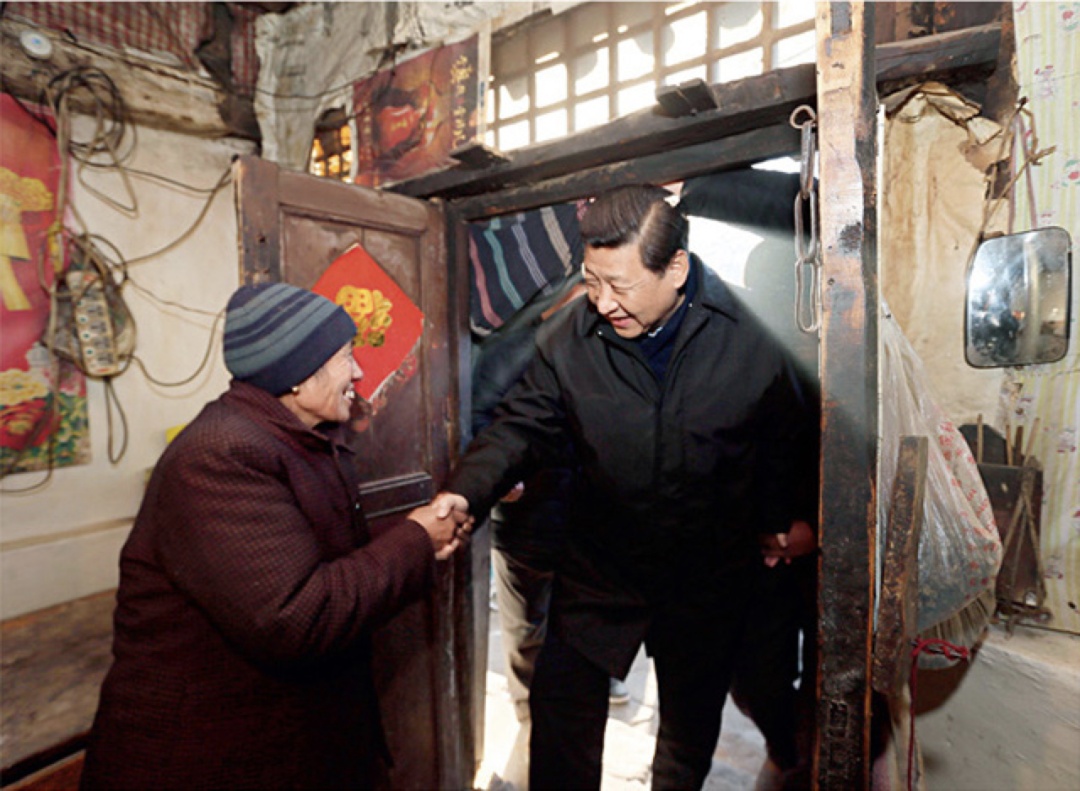
On December 30, 2012, the Supreme Leader visited Luotuowan Village, Fuping, Hebei Province to express his condolences to the needy people. Xinhua News Agency reporter Lan Hongguang photo
Is there a good way to accurately identify poor households?
On June 18, 2015, at the symposium on poverty alleviation and economic and social development during the 13 th Five-Year Plan period in some provinces, autonomous regions and municipalities, the top leaders talked about accurately identifying the "four views": first, looking at the house, second, looking at the grain, third, looking at whether the labor force is strong or not, and fourth, looking at whether there is a scholar at home.
This method was explored in practice in Yina Town, Weining County, Guizhou Province. It is practical, intuitive and easy to operate, and the supreme leader affirmed it: "‘ Four views ’ The actual effect is good, and it works in practice. It is a creation and can be continuously improved in practice. "
The Supreme Leader also mentioned the story of Jiao Yulu. During his 475 days in Lankao, Comrade Jiao Yulu visited and investigated more than 120 of the 149 production brigades in the county with a bicycle and a pair of iron footboards, and asked questions and discussed with the masses. It is this in-depth investigation and study that enabled him to basically master the laws of waterlogging, sandstorm and salinity in a relatively short period of time and implement the correct decision to control the "three evils".
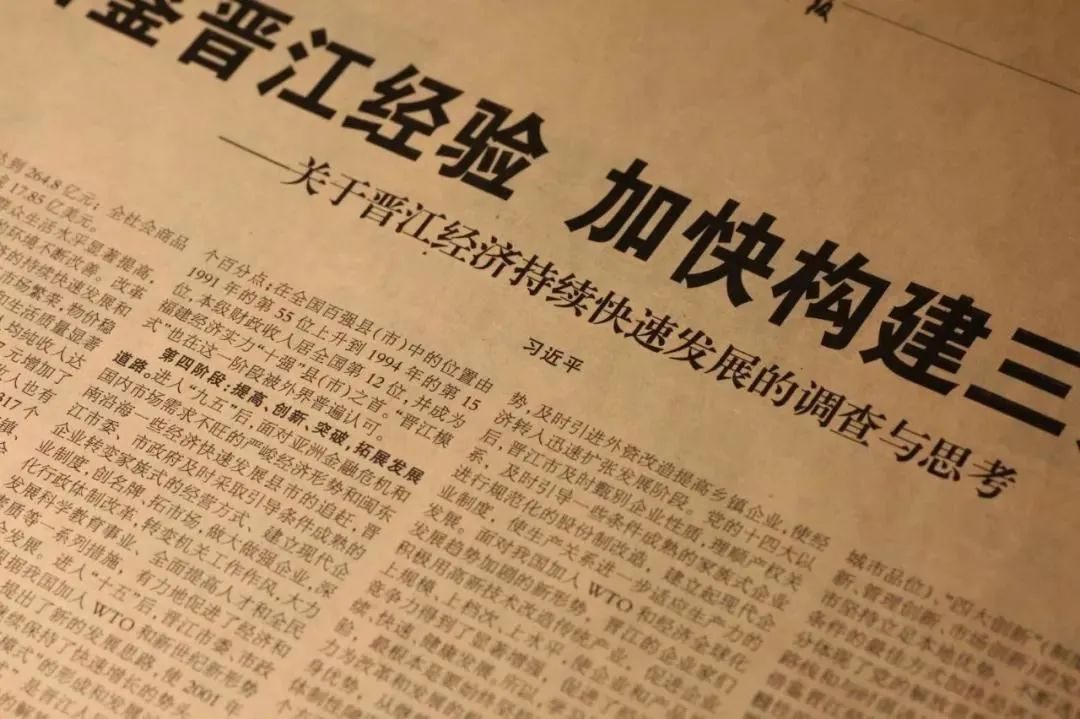
In October, 2002, Fujian Daily published an article signed by the Supreme Leader, entitled "Studying and Learning from Jinjiang’s Experience to Accelerate the Construction of Three Strategic Channels — — Investigation and reflection on the sustained and rapid economic development of Jinjiang. (Source: CCTV)
After the reform and opening-up, Jinjiang, Fujian Province, started from organizing idle houses, idle capital and idle laborers to start businesses, and explored a road of economic development with "market economy as the mainstay, export-oriented economy as the mainstay, joint-stock cooperative system as the mainstay, and various economic components developing together", realizing a historical leap from backward and poor counties to "Top Ten Counties (Cities) in China".
The supreme leader is very concerned about the development of Jinjiang. During his work in Fujian, he visited Jinjiang seven times in six years, and summed up and put forward the "Jinjiang Experience" with "Six Persistences" and "Correctly Handling Five Relationships" as the main contents, which still has strong practical guiding significance.
Grassroots are good classrooms and the masses are good teachers. The Supreme Leader said, "Where are the good measures and methods? The answer is from the masses. "