The reporter’s comments on the investigation of "rewarding" chaos in live webcasts are shocking.
CCTV News:In recent years, with more and more users sharing their lives, showing their talents and launching social activities on the webcast platform, the attention of the webcast platform is getting higher and higher, but it also exposes some problems, such as bad performances and propaganda of getting rich overnight. Recently, an article describing that a network anchor won a reward of 10 million yuan from netizens in a short time was circulated, and getting rich by "rewarding" caused controversy. In this regard, our reporter launched an investigation.

Reporter:This is a live broadcast of a network anchor on a certain platform, and some viewers keep giving her virtual gifts. This gift called "Supreme Guardian" is equivalent to RMB 10,000. In a live broadcast, the anchor received 30 gifts with a total value of RMB 300,000.
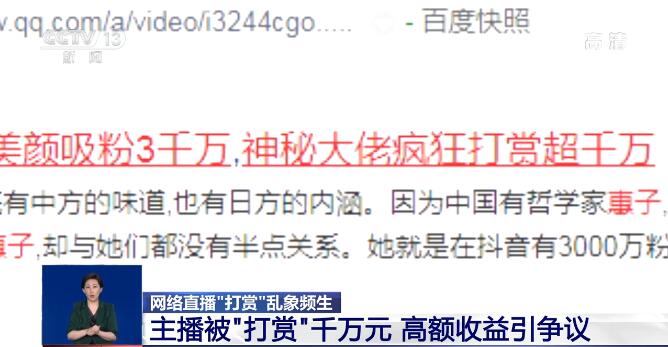
Not long ago, an article about the anchor’s "reward" of 10 million yuan in a short time was circulated on the Internet, in which it was said that she had broadcast more than 600 live shows in recent years, and accumulated virtual gifts equivalent to 30 million yuan. The "reward" mentioned in it refers to the audience buying virtual currency through the live broadcast platform and then converting it into virtual gifts for the anchor. The live broadcast platform will convert the value of the "reward" gift and share it with the anchor, which is an important source of income for them.
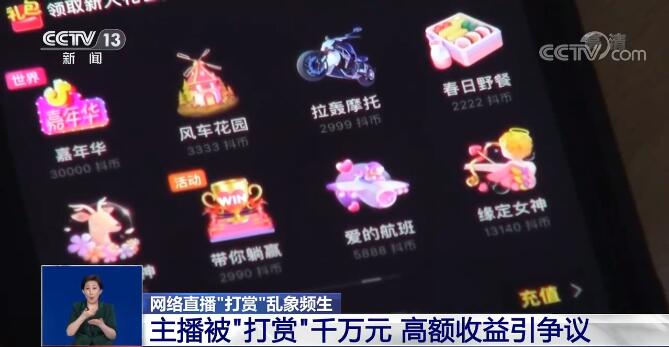
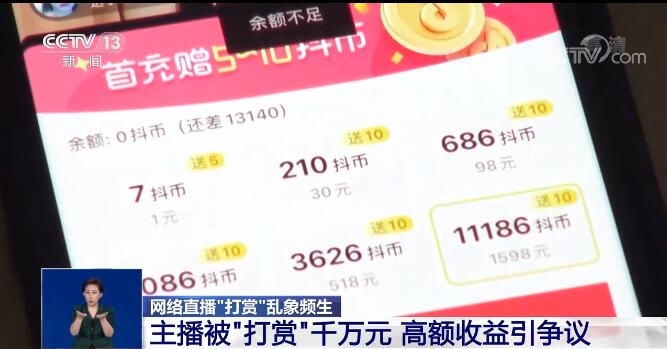
In order to get a "reward", the anchor will try to get fans to "brush gifts". This is an online PK game between an anchor and another network anchor. The rule is to compare the number of gifts given by fans of the two sides within a specified time, and the loser will be punished by the game. Some fans keep giving gifts to support their favorite network anchors. On this network platform, the highest bid is the "Supreme Salute" with 66,666 coins, equivalent to RMB 9,523.
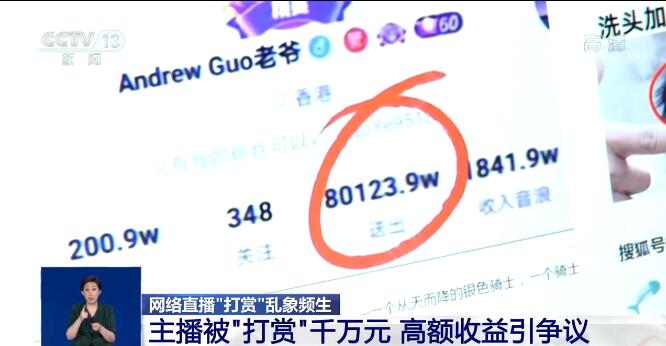
In recent years, some media have been speculating about this network female anchor’s "earning more than 5 million RMB a day at most" and other information about huge rewards. Among those who rewarded her, a gift from an account named "Laoye" exceeded RMB 80 million. Just as everyone was talking about the real identity of this person, the account quietly changed its screen name and disappeared from the network.
Although the authenticity of "huge rewards and profits" needs to be verified, the behaviors and propaganda of attracting netizens to "reward and profit" with this "routine" frequently appear on the Internet, impacting social psychology.
Netizen: Too high this amount may cause this vanity and comparison in society.
Netizen:Some anchors use some PUA (emotional manipulation) or even flattering means to earn rewards, which is also disrespectful to users.
Tong Lihua, Director of Beijing Youth Legal Aid and Research Center:In this way, there are tens of millions or even hundreds of millions of rewards, but how many real rewards are behind it, this information is not completely inaccurate. It is very harmful to the formation of minors’ outlook on life to create a false phenomenon of getting rich overnight for nothing in the whole society, especially among minors.
False means to hype "online celebrity" to induce netizens to consume.
In the investigation, the reporter found that some network anchors and platforms will use some false means to obtain "rewards", such as finding "trust" to pretend to be fans, forging anchor popularity traffic data, etc., to induce unsuspecting netizens to follow suit.
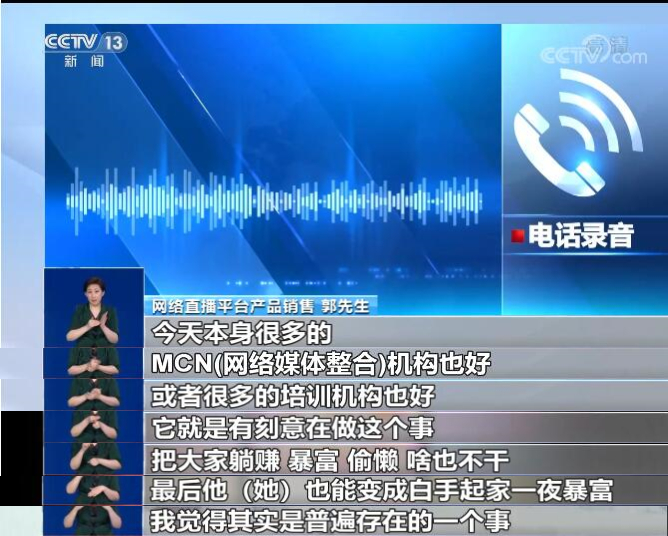
Xiao Wang, the post-95 s network anchor, told reporters that some anchors’ behavior of stimulating fans to reward through Lianmai PK is called "cheating tickets", which is called "cheating" because there are a lot of routines. For example, the operation team will pretend to be fans to brush gifts, create a tense atmosphere, and then defraud netizens to follow suit and reward.
Network anchor Xiao Wang:In fact, they are all people inside the company. We pretend we don’t know each other and then PK. Because several of my friends have four or five million fans in Tik Tok, they sometimes brush some gifts like this, and their active popularity is basically the same.
Traffic data fraud raises the psychological price of fans brushing gifts
In order to improve the popularity of the anchor and attract the audience, the live data will also be faked. Under the team operation, the number of real-time online users only needs to change the settings in the background, and all the traffic in the accumulated time period can be counted. In addition, there is a "multiple" operation, which can make the number of presenters 1000 times or even more than the real data, so as to increase the anchor price and raise the psychological price of fans to brush gifts.
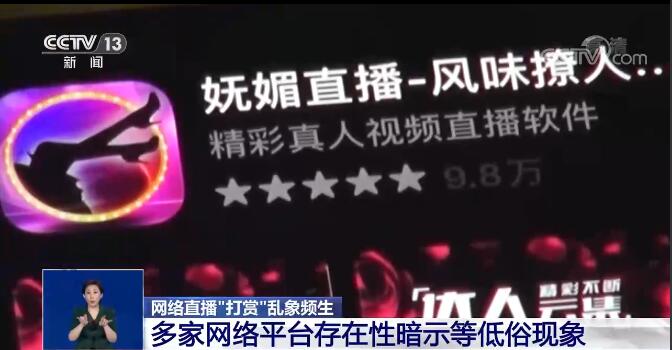
There are vulgar phenomena such as sexual suggestion in many online platforms.
In order to increase the reward amount, some anchors attract users by revealing clothes, frivolous words, promising to give gifts "to welfare", and even seduce "reward" by means of sexual hints and soft pornography, resulting in bad information existing in the webcast platform.
On a live broadcast platform, the reporter randomly entered the "hot" section recommended by him, and found that it contained live broadcasts with sexual hints and induced users to reward.
The network anchor is scantily dressed and foul-mouthed, with only one purpose — — Let netizens recharge their rewards. Some anchors don’t show their faces, but aim the camera at a certain part of the body all the time, while others induce users to browse with exposed clothes through so-called sports display and game explanation, and then become so-called "fans". Xiao Wang, who has experience in webcasting, said that this kind of "soft pornography" is a quick way to get rewards for webcasting.
Network anchor Xiao Wang:The only income of the anchor depends on your face, but if you are not so beautiful and brilliant, you will broadcast live for 4 hours today, but there may be no income. Now that it’s live, it must be done in the most profitable way, right?
In order to maximize revenue, network anchors attract netizens’ attention through words and limbs. Through investigation, the reporter found that such a routine has become an industry rule and appeared in many webcast platforms.

Tian Feng, a researcher at the Institute of Social Development Strategy of China Academy of Social Sciences:Many platforms have contracts with MCN organizations, and MCN organizations will choose anchors that may bring potentially huge traffic and reward amount. As for how the anchors broadcast, there may be a tacit understanding and compromise between this platform and MCN organizations, which will make the anchors do some side-scratching, because their goal is simple, that is, to bring traffic and reward amount.
According to statistics, since 2018, the number of webcasting apps has continued to rise. At present, there are more than 240 webcasting apps in Apple system alone. When the reporter searches for the word "live broadcast" in the mobile APP store, he will see a large number of APP recommendations pop up. The sexually suggestive words such as "late night beauty", "private video" and "sultry" are directly included in the name of the app, and what’s more, the words "chat" are directly typed to induce users to download and use it.
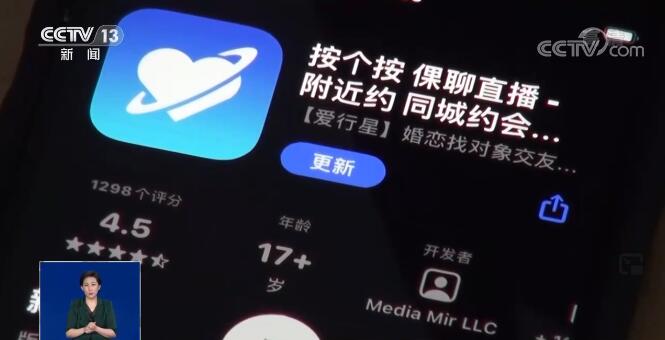
The chaos of "rewarding" misleads young people and encourages bad social atmosphere.
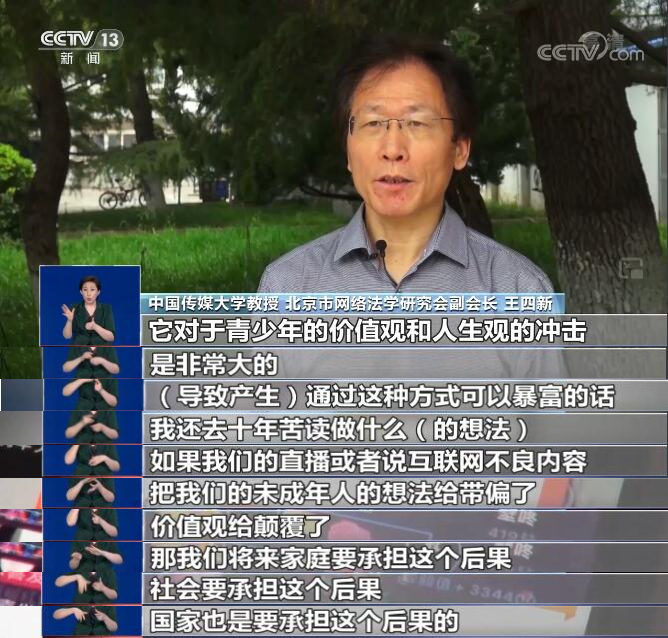
In view of the problems existing in webcasting, experts said that the influence scope of "rewarding" webcasting has gradually expanded, which has led some minors to go astray and affected the values of young people. This phenomenon of money first and reward by comparison is easy to encourage bad social atmosphere.
The reporter’s investigation found that there are a large number of college students’ anchors on many online platforms. Some girls are scantily dressed and coquettish, "seeking rewards", and some college students broadcast live in the dormitory "in groups".

In the investigation of the ecology of webcasting industry, the Youth and Social Issues Research Office of China Academy of Social Sciences found that a large number of college students have a strong yearning to become anchors. Since the media hyped information such as "the anchor won a sky-high reward" and "the anchor became a shortcut to get rich" on the Internet, some young college students have formed a "deformed" view of getting rich by selling jokes and coquetry.
Netizen:It is inconceivable that online celebrity will become rich, which will make contemporary young students think that it is more profitable to be a online celebrity than to study hard.
Teenagers’ cognitive ability and self-control ability are weak, and they can’t stand the inducement of the anchor to "reward" and "seek reward". Driven by their vanity and comparison, they reward the anchor without stint. Not long ago, a 15-year-old boy from Nantong, Jiangsu, rewarded all the 80,000 yuan medical treatment money accumulated by his grandparents to a network platform anchor, and the single recharge amount reached 10,000 yuan one day.
In recent years, examples of using savings or even misappropriating public funds to reward anchors have often appeared. These reports are shocking, such as more than 2.5 million yuan for the dead husband, more than 100,000 yuan for the poor students’ loans, and 48.26 million yuan for the post-90s male cashier to reward the anchor 20 million a year. In order to maintain contact with the anchor, some netizens do not hesitate to "reward" beyond their financial ability, which has a negative impact on the family or society.
Grasping and managing the chaos of "rewarding" together urgently needs systematic rectification.
In view of the "reward" chaos in webcasting, the website platform should fulfill the main responsibility, strengthen the audit, and solve the bad phenomena and behaviors from the source. In recent years, the relevant state departments have successively issued a series of regulatory policies, and gradually formed a standardized governance system in the process of joint management.
We should improve the "youth model" and the anti-addiction function.
According to the requirements of the National Internet Information Office, many video platforms have launched "Youth Mode" and anti-addiction functions. In this mode, teenagers can’t watch the live broadcast, reward and recharge, and they will be forced to log off the line after 40 minutes of cumulative use every day, and they can’t log in from 10 pm to 6 am.
Sexual suggestion and other "edge ball" behaviors need to be continuously rectified.
In order to pursue traffic and attract attention, some network platforms use algorithm technology to push audio and video content that violates social public order and good customs to users; Some network platforms hide evils and practices, allowing anchors to spread sexual hints or pornographic information, and even luring users to engage in illegal transactions across platforms. In this regard, the national network information department has carried out many rectification and strict supervision.
Make concerted efforts to strengthen the standardized management of webcasting
On November 23, 2020, the State Administration of Radio, Film and Television issued the Notice on Strengthening the Management of Online Show Live Broadcasting and E-commerce Live Broadcasting, which strictly stipulated that underage users should not be rewarded and that it is forbidden to hint, seduce or encourage users to "reward" in large amounts. On February 9 this year, seven state departments jointly issued the Guiding Opinions on Strengthening the Standardized Management of Webcast, emphasizing that the Webcast platform should set a reasonable upper limit for a single virtual consumer product and a single reward amount; The newly revised "People’s Republic of China (PRC) Law on the Protection of Minors" will be implemented on June 1st this year. It is proposed that webcasting service providers should set up corresponding functions such as time management, authority management and consumption management for minors to use their services.